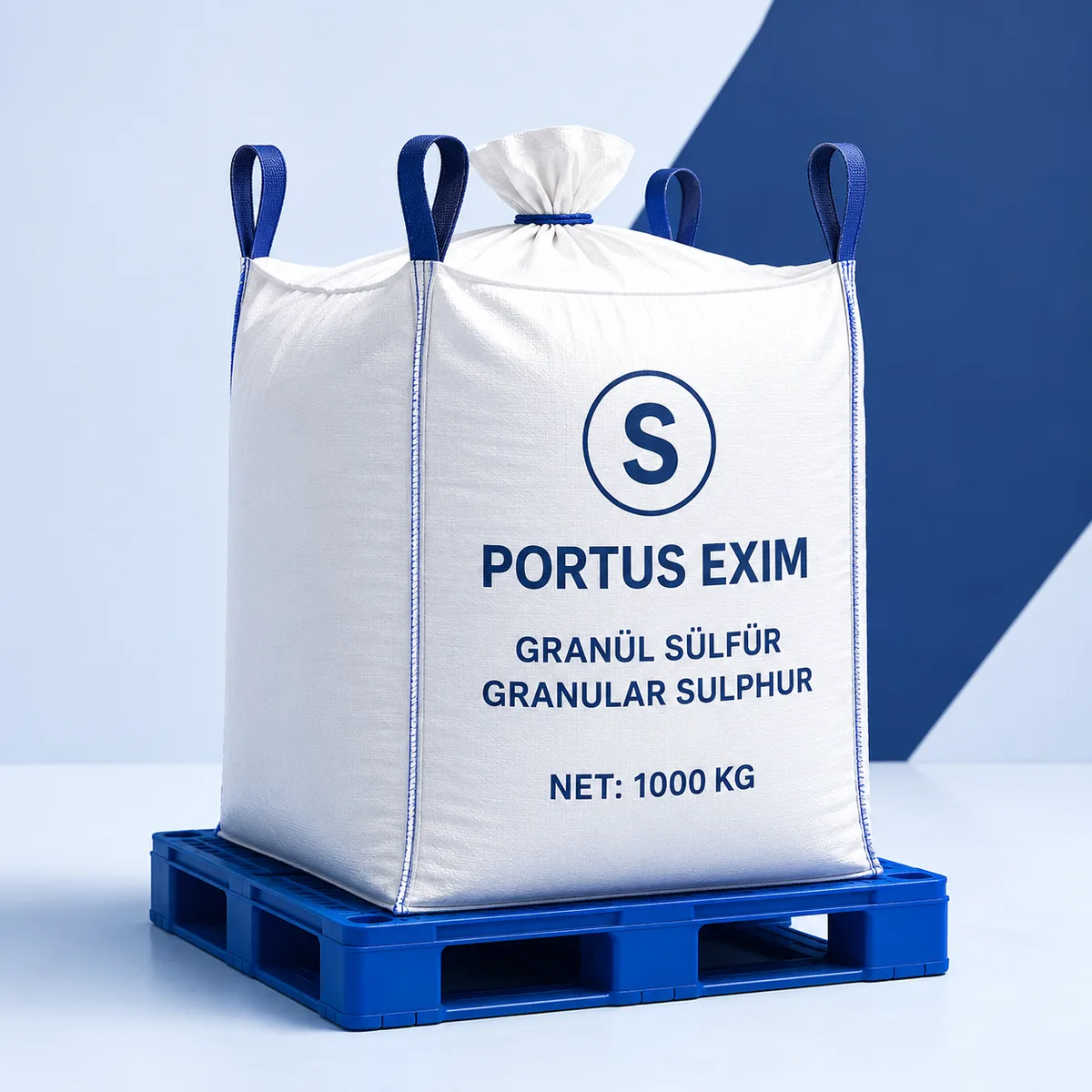
 Granular
Granular
Granular
Sulphur · Granular Form
Granular Sulphur
Free-flowing, low-dusting industrial sulphur produced by controlled cooling of molten sulphur on a granulation line.
View details ↘
PORTUS EXİM · SULPHUR PORTFOLIO
High-purity, refinery-sourced sulphur in granular, prilled, powder and lump forms. Certified supply for the fertiliser, chemical, rubber and mining sectors.
Explore the portfolio01 · CHOOSING A FORM
The chemistry of sulphur is identical in every form; what differs is the particle structure, dissolution rate and handling behaviour. Choosing the right form affects both process efficiency and logistics cost.
| Form | Particle structure | Key characteristic | Typical use |
|---|---|---|---|
| Granular | 2–6 mm, hard spherical | High mechanical strength, low dusting | Fertiliser, long-haul shipment |
| Prilled | 1–4 mm, hemispherical | Fast dispersion, uniform dosing | Sulphuric acid, melting lines |
| Powder | 325 mesh (≈45 µm) | High surface area, fast reaction | Rubber, agricultural spraying |
| Lump | 0–50 mm, irregular | Lowest unit cost | High-volume industrial feedstock |
02 · PRODUCTS BY FORM
Granular
Granular
Sulphur · Granular Form
Free-flowing, low-dusting industrial sulphur produced by controlled cooling of molten sulphur on a granulation line.
View details ↘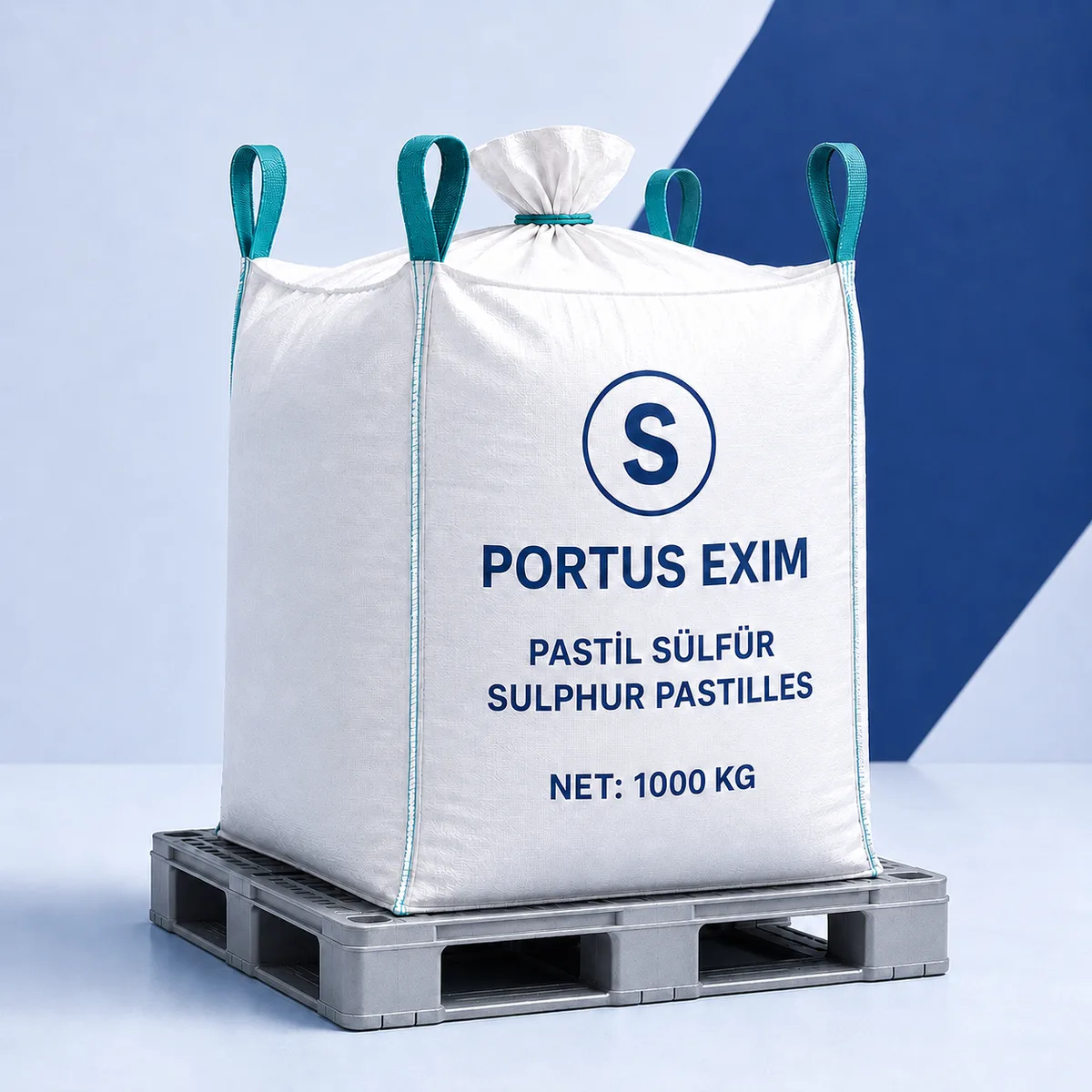 Prilled
Prilled
Prilled
Sulphur · Prilled Form
A uniformly sized, fast-dissolving hemispherical form obtained by dropping molten sulphur onto a cooling belt.
View details ↘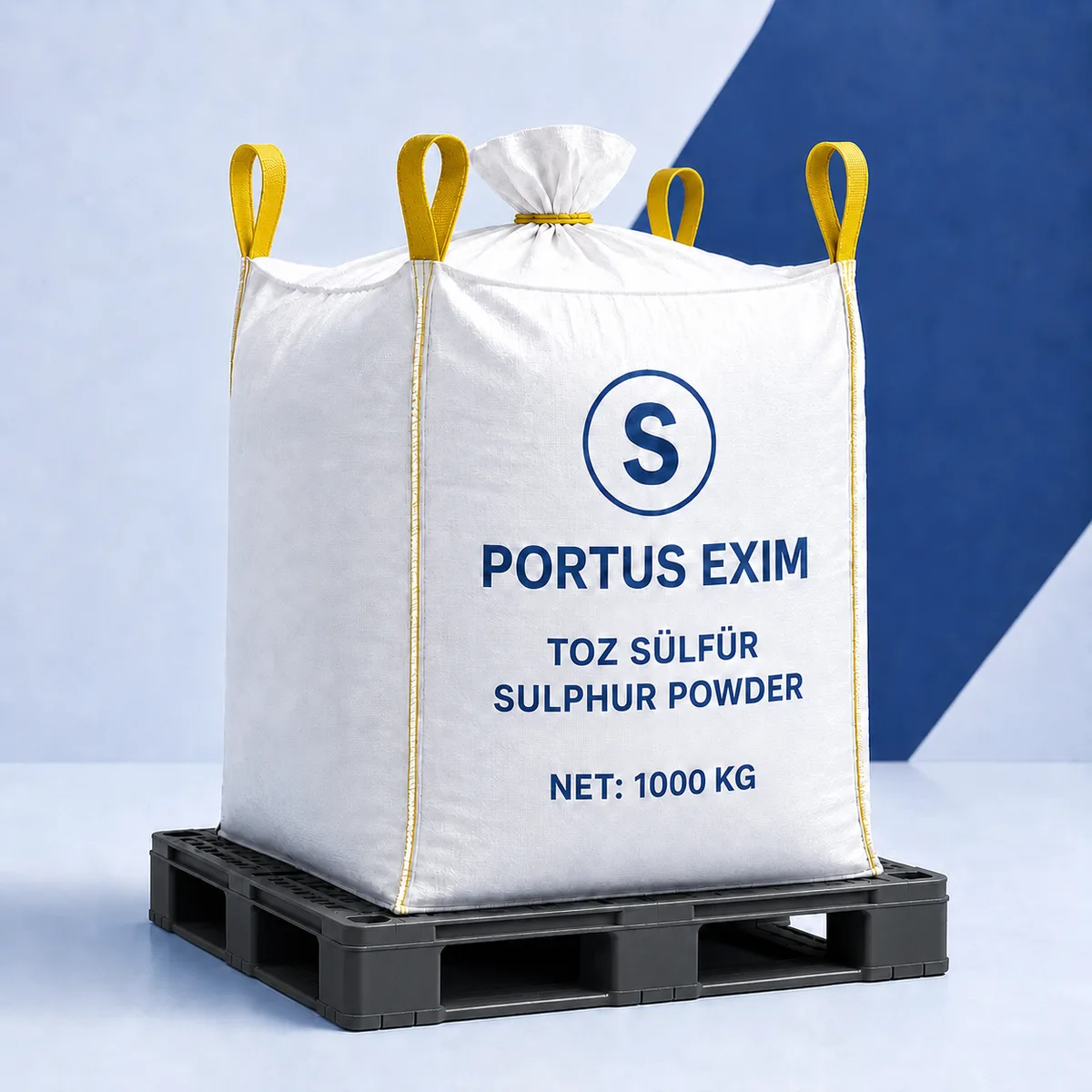 Powder
Powder
Powder
Sulphur · Ground (Micronised) Form
Ground and screened down to micron level, this form reacts quickly thanks to its high surface area.
View details ↘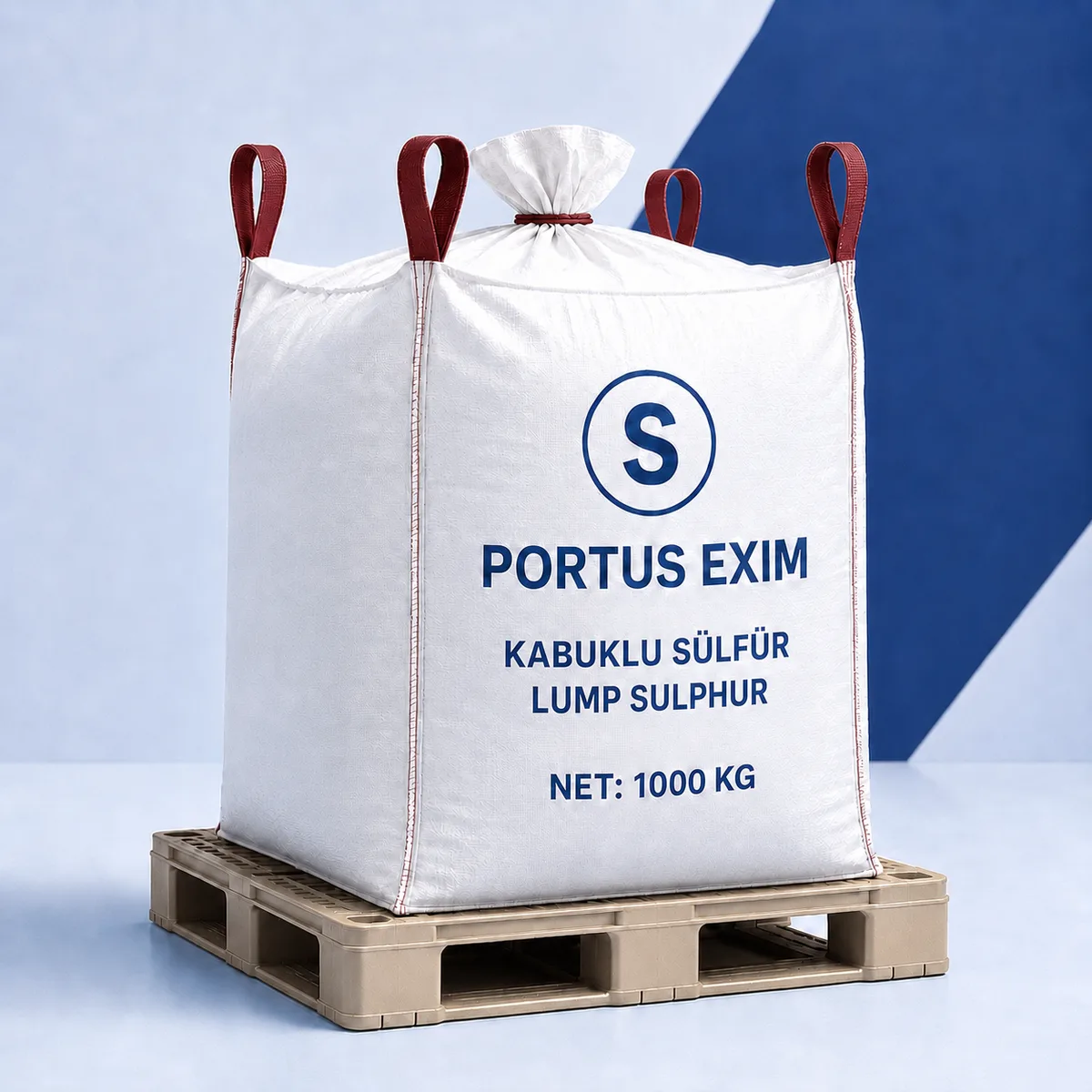 Lump
Lump
Lump
Lump
Sulphur · Crushed Lump Form
Obtained by crushing solidified sulphur blocks — the economical form for high-volume industrial purchasing.
View details ↘
Granular
Granular
Category: Sulphur
Granular sulphur is produced by cooling and solidifying, in a controlled water-cooled granulation line, the molten sulphur recovered from acid gases at refineries and natural gas processing plants. The resulting spherical particles have a hard shell and low porosity, which minimises breakage and dusting losses during transport and handling.
Its free-flowing structure allows uninterrupted operation in silo discharge, conveyor transport and automatic dosing systems. Low moisture content prevents caking during storage, while the bright yellow, uniform appearance makes it easy for the buyer to verify acceptance criteria visually. The mechanical strength of the granular form is a decisive advantage on long-haul sea shipments and routes involving multiple transhipments.
Principal applications include sulphur-based and compound fertiliser production, soil pH adjustment, sulphuric acid plants, leaching processes in mining, and the chemical industry. Applied to soil in agricultural use, it oxidises gradually, meeting the plant’s sulphur requirement while improving the availability of phosphorus and micronutrients.
Portus EXİM sources granular sulphur from refinery-origin supply and arranges sampling, analysis and tonnage determination through an independent inspection company before loading. Particle size distribution, moisture content and packaging type are planned around the buyer’s feed system.
| Packaging | Big bag (1,000/1,250 kg), 25–50 kg bags, bulk |
|---|---|
| Purity (sulphur, dry basis %) | 99.90 min |
| Moisture (%) | 0.50 max |
| Ash (%) | 0.05 max |
| Acidity (as H₂SO₄, %) | 0.01 max |
| Organic matter (%) | 0.03 max |
| Arsenic / Selenium / Tellurium (ppm) | 1 max |
| Particle size (mm) | 2–6 (95% min) |
| Appearance | Bright yellow, spherical granules |
| Bulk density (kg/m³) | 1,150–1,250 |
| Melting range (°C) | 115–120 |
| Transport classification | IMSBC Group C · low fire risk |
Values shown are typical analysis results; the final specification is confirmed by the certificate of analysis (COA) issued per batch.
Prilled
Prilled
Category: Sulphur
Prilled sulphur is produced by releasing molten sulphur onto a cooling belt in even droplets that then solidify. The resulting hemispherical particles have a more porous internal structure than the granular form, which allows them to disperse faster in water and in the melt.
This rapid dispersion makes the prilled form particularly advantageous in sulphuric acid production lines and at plants feeding a melting kettle. Because the particle size falls within a narrow range, deviation in gravimetric and volumetric dosing systems is reduced and the stability of the process input improves.
Low moisture and low acidity limit the risk of corrosion and caking in long-term storage. Its uniform appearance and low dusting make it the preferred choice for bagged sales and for packaging that reaches the end user.
Portus EXİM plans prilled sulphur in the particle size range suited to the buyer’s feed equipment, and agrees big bag, bagged or bulk shipment options according to the destination port and storage conditions.
| Packaging | Big bag (1,000/1,250 kg), 25–50 kg bags, bulk |
|---|---|
| Purity (sulphur, dry basis %) | 99.80 min |
| Moisture (%) | 0.50 max |
| Ash (%) | 0.05 max |
| Acidity (as H₂SO₄, %) | 0.02 max |
| Organic matter (%) | 0.05 max |
| Particle size (mm) | 1–4 |
| Appearance | Yellow, hemispherical prills |
| Bulk density (kg/m³) | 1,100–1,200 |
| Melting range (°C) | 115–120 |
| Transport classification | IMSBC Group C · low fire risk |
Values shown are typical analysis results; the final specification is confirmed by the certificate of analysis (COA) issued per batch.
Powder
Powder
Category: Sulphur
Powder sulphur is obtained by grinding and screening granular or lump sulphur. As particle size decreases, surface area per unit mass increases, giving a decisive advantage in applications where reaction rate and uniform dispersion matter.
In rubber vulcanisation, how finely the sulphur is ground directly affects the quality of its reaction with the rubber, which is why tyre production consumes high-fineness powder sulphur. In agricultural spraying, the powder form creates a thin, continuous film on the leaf surface, giving protective action against fungal diseases.
Applications include the rubber and tyre industry, agricultural spraying and soil amendment, matches and pyrotechnics, paint and pigment production, and various chemical synthesis processes. Particle size distribution (200 mesh, 325 mesh, etc.) is set according to project requirements.
Because the powder form tends to generate dust, closed-system handling, earthing and appropriate personal protective equipment are recommended. Shipment is usually planned in palletised bags or big bags; on request, the material safety data sheet (MSDS) and certificate of analysis are shared before loading.
| Packaging | 25–50 kg bags (palletised), big bag |
|---|---|
| Purity (sulphur, dry basis %) | 99.50 min |
| Moisture (%) | 0.50 max |
| Ash (%) | 0.10 max |
| Acidity (as H₂SO₄, %) | 0.03 max |
| Fineness — through 325 mesh (≈45 µm) | 98% min |
| Fineness — through 200 mesh (≈75 µm) | 99.5% min |
| Appearance | Pale yellow, fine powder |
| Bulk density (kg/m³) | 550–750 |
| Transport classification | UN 1350 · IMDG Class 4.1 (bagged) |
Values shown are typical analysis results; the final specification is confirmed by the certificate of analysis (COA) issued per batch.
Lump
Lump
Category: Sulphur
Lump sulphur is the irregularly grained form obtained by passing sulphur — solidified in pits or blocks — through crushers. Because it involves no forming step (granulation or prilling), its unit cost is lower than that of the other forms.
This cost advantage is decisive for large-scale plants that melt sulphur and feed it directly into the process. In sulphuric acid production and metallurgical processes, what matters is chemical purity and moisture rather than particle shape, so the lump form is preferred.
Particle size is distributed across a wide range; a fraction suited to the buyer’s crusher and feed system can be requested. The proportion of fines is defined together with tolerance limits at the contract stage.
In sea transport, lump and coarse-grained sulphur falls under IMSBC Code Group B and IMDG Class 4.1 (UN 1350). For shipments in this category, Portus EXİM carries out the required declaration, segregation and pre-loading checks together with the shipowner and agent.
| Packaging | Bulk, big bag (1,000/1,250 kg) |
|---|---|
| Purity (sulphur, dry basis %) | 99.50 min |
| Moisture (%) | 1.00 max |
| Ash (%) | 0.10 max |
| Acidity (as H₂SO₄, %) | 0.03 max |
| Organic matter (%) | 0.10 max |
| Particle size (mm) | 0–50 (fraction on request) |
| Appearance | Yellow, irregular lumps and pieces |
| Bulk density (kg/m³) | 1,100–1,300 |
| Transport classification | UN 1350 · IMSBC Group B / IMDG Class 4.1 |
Values shown are typical analysis results; the final specification is confirmed by the certificate of analysis (COA) issued per batch.
03 · QUALITY AND LOGISTICS
Batches from refineries and gas processing plants are sampled by an independent inspection company before loading; purity, moisture and acidity values are documented in a certificate of analysis.
Big bag, 25–50 kg palletised bags and bulk options are decided by taking into account the destination port, storage conditions and the buyer's discharge equipment.
Granular and prilled forms are treated as low fire-risk under IMSBC Group C. Lump and coarse-grained sulphur is carried under a UN 1350 · IMDG Class 4.1 declaration.
Bill of lading, certificate of origin, certificate of analysis, MSDS and inspection report are completed on the same schedule as the shipment and shared with the buyer.
Pricing by tonnage, form and destination port.